
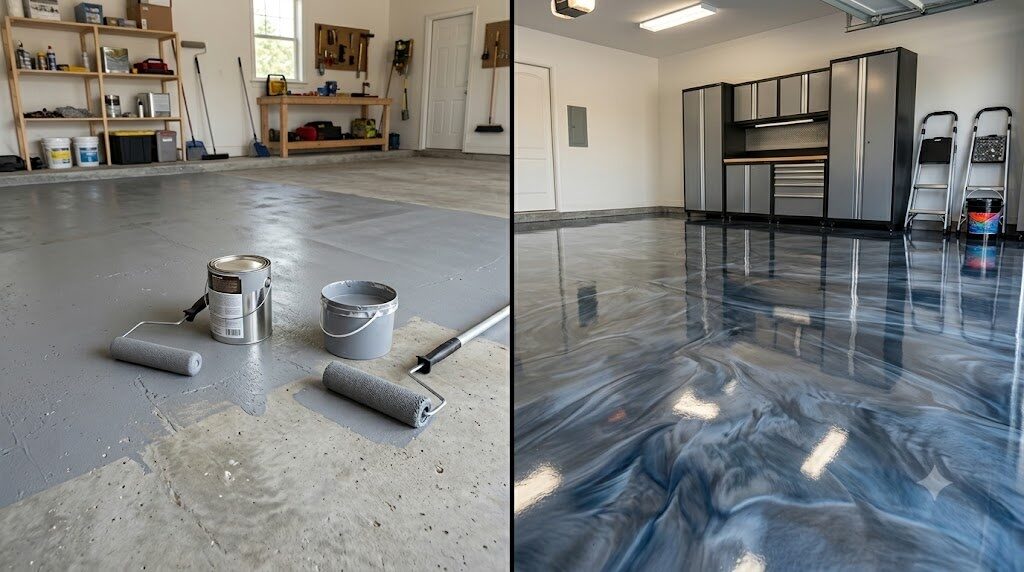
Epoxy Floor Paint vs Epoxy Flooring – Which One Does Your Facility Need?
Understanding epoxy floor paint vs epoxy flooring is one of the most important decisions you will make before investing in any floor coating project. If you are currently researching epoxy floor paint vs epoxy flooring, you are in exactly the right place. This complete 2026 guide on epoxy floor paint vs epoxy flooring covers cost, durability, installation, chemical resistance, and lifespan — so you can make a confident, informed decision for your industrial or commercial space in Konanakunte, Bengaluru.
Are you planning a new factory floor near Kanakapura Road or upgrading a commercial warehouse close to the Bengaluru South industrial belt? If so, you have almost certainly come across two terms that sound similar but perform very differently. The epoxy floor paint vs epoxy flooring comparison may appear straightforward on the surface, but the technical differences between these two products are enormous — and choosing the wrong one will cost you significantly more in the long run.
This guide is brought to you by Polyfinish — Bengaluru’s trusted industrial floor coating specialists based in Konanakunte. We break down every difference in plain language so that factory owners, facility managers, warehouse operators, and commercial property developers across Konanakunte, Doddakallasandra, JP Nagar, Banashankari, Kumaraswamy Layout, Gottigere, Anjanapura, and surrounding areas can make the right call.
What Is the Difference Between Epoxy Floor Paint and Epoxy Flooring?
The epoxy floor paint vs epoxy flooring debate begins with understanding what each product is made of. Most buyers searching for epoxy floor paint vs epoxy flooring information are surprised to learn how technically different these two products are. When evaluating epoxy floor paint vs epoxy flooring, the resin content, film thickness, and bonding mechanism are the three defining factors that separate a decorative paint from a structural floor system.
Before comparing the two in detail, you need to understand what each product actually is. Many property owners in Bengaluru’s industrial corridors — from the KIADB plots near Banashankari to the warehouses lining Uttarahalli Road — have invested in the wrong solution simply because of a labelling confusion.
What Is Epoxy Floor Paint?
Epoxy floor paint is a water-based or solvent-based coating product that contains a small percentage of epoxy resin — typically between 40% and 60% solids content. It is sold in single-component tins, applied like regular paint using a roller, and dries within a few hours.
Because it is essentially modified paint, it sits on top of the concrete rather than bonding chemically with it. The film thickness after application is typically just 2 to 4 mils (0.05 to 0.1 mm), which is extremely thin for any meaningful industrial protection.
What Is Epoxy Flooring?
Epoxy flooring — also called an epoxy floor system or epoxy floor coating — is a two-component system made of 100% solids epoxy resin combined with a hardener. When these two components are mixed, a chemical reaction called polymerisation occurs, creating a thick, rigid, plastic-like surface that bonds directly to the concrete substrate at a molecular level.
Depending on the system specified, epoxy flooring is applied at thicknesses ranging from 300 microns for a self-levelling primer coat to 6 mm or more for heavy-duty industrial systems with broadcast aggregates. This is why it is considered a true floor system and not just a surface coating.
The key distinction in the epoxy floor paint vs epoxy flooring debate is this: epoxy floor paint is a decorative surface treatment, while epoxy flooring is a structural floor system. That single difference drives every other comparison in this guide.
📊 COMPARISON TABLE 1: Epoxy Floor Paint vs Epoxy Flooring — Technical Snapshot
| Feature | Epoxy Floor Paint | Epoxy Flooring System |
|---|---|---|
| Resin Content | 40–60% solids | 100% solids |
| Dry Film Thickness | 2–4 mils | 300 microns to 6 mm+ |
| Bonding Mechanism | Surface adhesion | Chemical bond to concrete |
| Installation Method | DIY roller application | Professional multi-step process |
| Curing Time | 24–48 hours | 5–7 days full cure |
| Lifespan | 1–3 years | 10–20+ years |
| Chemical Resistance | Low to moderate | High to very high |
| Load Bearing Capacity | Light foot traffic only | Heavy machinery and forklifts |
| Cost per sq.ft. (India) | ₹15–₹35 | ₹60–₹200+ |
| Best For | Residential garages, small offices | Factories, warehouses, pharma, food plants |
Which Is More Durable — Epoxy Floor Paint or Epoxy Flooring?
When comparing epoxy floor paint vs epoxy flooring on durability, the difference is not marginal — it is generational. The epoxy floor paint vs epoxy flooring durability gap is the primary reason industrial clients across Bengaluru’s factory belts consistently choose professional flooring systems over paint products. Any honest epoxy floor paint vs epoxy flooring comparison must begin with film thickness and adhesion strength, because those two factors determine everything else.
Why Epoxy Floor Paint Wears Out Quickly
Because epoxy floor paint only sits on the surface of the concrete without a true chemical bond, it begins to peel, chip, and delaminate under any meaningful stress. In Bengaluru’s extreme summer heat — with temperatures in Konanakunte and surrounding areas regularly touching 35–38°C — thermal expansion causes the thin paint film to crack within months.
Forklift traffic, pallet dragging, and even heavy foot traffic in busy commercial spaces create micro-abrasions that break down the film within one to two years. Moisture vapour transmission from the concrete slab — a common issue in basements and ground-floor factories near Gottigere and Yelachenahalli’s low-lying plots — also causes epoxy floor paint to bubble and lift rapidly.
Why Epoxy Flooring Systems Last Decades
A professionally installed epoxy flooring system from an experienced contractor like Polyfinish chemically cross-links with the concrete, creating a surface that is literally part of the substrate. The compressive strength of a quality industrial epoxy system exceeds 70 N/mm² — higher than standard concrete itself.
With proper maintenance, industrial epoxy flooring in a well-managed factory or warehouse in Bengaluru can realistically last 15 to 20 years before any major renovation is needed. Many pharmaceutical plants and food-processing units near the Bommasandra and Jigni industrial areas have epoxy systems installed a decade ago that are still performing at full capacity today.
Verdict: For any space with machinery, vehicles, or high foot traffic, the epoxy floor paint vs epoxy flooring durability comparison clearly favours professional epoxy flooring systems.
How Long Does Epoxy Floor Paint Last Versus Epoxy Flooring?
Lifespan is one of the most practical ways to evaluate epoxy floor paint vs epoxy flooring. When you examine epoxy floor paint vs epoxy flooring side by side over a 10-year period, the long-term value of a proper flooring system becomes impossible to ignore.
Lifespan of Epoxy Floor Paint
In light-use residential settings such as a home garage or a small storage room, epoxy floor paint can last between 1 and 3 years before it needs repainting. In any commercial or industrial context — warehouses near Doddakallasandra, retail shop floors in JP Nagar, or dispatch areas in Kumaraswamy Layout — the lifespan drops to under 12 months under regular operational conditions.
Lifespan of Industrial Epoxy Flooring
A properly installed industrial epoxy flooring system will last 10 to 20 years in most applications. Heavily trafficked areas with aggressive chemical exposure — such as chemical storage rooms, battery charging bays, or food-processing zones — may see a lifespan of 8 to 12 years before a re-coating is recommended. Even then, only the top wear coat typically needs refreshing, not the entire system.
At Polyfinish, projects completed for clients near the industrial zones along the Kanakapura Road corridor have consistently shown zero delamination or structural failure five to seven years post-installation under continuous forklift operation. You can learn more about their experience and client history on the Polyfinish About Us page
Is Epoxy Flooring Worth the Extra Cost Compared to Epoxy Floor Paint?
For residential use with minimal traffic, epoxy floor paint might suffice as a short-term cosmetic improvement. But for nearly every commercial and industrial application, the answer to this epoxy floor paint vs epoxy flooring value question is an unambiguous yes — epoxy flooring is worth every extra rupee invested.
Understanding the True Cost of Epoxy Floor Paint
Epoxy floor paint in India costs between ₹15 and ₹35 per square foot for supply and application. However, when you factor in repainting every 1 to 2 years in a commercial setting, the 10-year total cost for a 2,000 sq.ft. factory floor looks like this:
- Year 1: ₹70,000 at ₹35/sq.ft.
- Year 2–3 Repaint: ₹70,000
- Year 4–5 Repaint: ₹70,000
- Year 6–7 Repaint: ₹70,000
- Year 8–9 Repaint: ₹70,000
- 10-year total: ₹3,50,000 or more, plus downtime costs for repeated repainting
The Real Cost of Industrial Epoxy Flooring
A professional industrial epoxy flooring system from Polyfinish for the same 2,000 sq.ft. facility might cost between ₹1,40,000 and ₹2,00,000 fully installed. With zero major remediation needed for a decade and only routine cleaning maintenance in between, the 10-year total cost is roughly half that of repeated epoxy floor paint applications — with far superior performance throughout every single year of that period.
This is exactly why facility managers at manufacturing plants near the KIADB Industrial Estate in Bengaluru consistently prefer investing in a quality epoxy flooring system upfront. Explore Polyfinish’s full range of industrial coating services to understand what a proper system specification includes.
How Much Does Epoxy Floor Paint Cost Compared to Epoxy Flooring?
Here is a clear, location-specific cost breakdown for the epoxy floor paint vs epoxy flooring decision, relevant to commercial and industrial property owners across Konanakunte, Bengaluru.
📊 COMPARISON TABLE 2: Epoxy Floor Paint vs Epoxy Flooring — Cost in Bengaluru 2026
| Cost Factor | Epoxy Floor Paint | Industrial Epoxy Flooring |
|---|---|---|
| Material Cost per sq.ft. | ₹10–₹20 | ₹40–₹120 |
| Labour Cost per sq.ft. | ₹5–₹15 | ₹20–₹80 |
| Total Installed Cost per sq.ft. | ₹15–₹35 | ₹60–₹200 |
| Recoating Frequency | Every 1–2 years | Every 10–20 years |
| Surface Prep Required | Minimal | Shot blasting or diamond grinding |
| Warranty Offered | None (DIY product) | Up to 5 years (professional) |
| 10-Year Cost for 2,000 sq.ft. | ₹3,00,000–₹3,50,000 | ₹1,40,000–₹2,00,000 |
Note: Costs vary based on surface condition, system specification, and site location. Contact Polyfinish at for a site-specific quote anywhere in Bengaluru.
Which Option Is Better for Industrial and Commercial Spaces?
For industrial and commercial properties, the epoxy floor paint vs epoxy flooring question has a clear answer that experienced engineers and facility managers unanimously agree on. The epoxy floor paint vs epoxy flooring suitability for industrial applications is determined by load-bearing capacity, chemical resistance, and substrate adhesion strength. Every credible epoxy floor paint vs epoxy flooring evaluation in a factory or warehouse setting reaches the same conclusion: only a professional epoxy flooring system meets the performance requirements of industrial operations.
If you manage or own an industrial or commercial facility anywhere in South Bengaluru — from the bustling commercial corridors of JP Nagar and Banashankari to the dense industrial clusters near Anjanapura Township or Arekere — this section answers your question directly.
Epoxy Floor Paint in Industrial Spaces — Not Recommended
Several industrial unit owners in Bengaluru’s outer ring area have made the costly mistake of using epoxy floor paint in their facilities, attracted by the lower upfront cost. The results are predictably poor: peeling in high-traffic forklift lanes, chemical staining in storage areas, and debonding within months in zones exposed to water or coolant.
The World Floor Covering Association and leading flooring industry bodies globally consistently advise against using thin-film epoxy paints in any space with machinery, vehicles, or chemical exposure. You can review international flooring industry standards and technical resources at https://www.concretedecor.net to understand why film thickness and adhesion strength matter so critically.
The Constructor — A comprehensive technical guide on epoxy floor types, applications, and specification standards
Industrial Epoxy Flooring — The Right Solution
For factories, warehouses, pharmaceutical units, food-processing plants, cold storage facilities, and commercial retail spaces, a properly engineered industrial epoxy flooring system is the only specification that makes engineering and financial sense.
Polyfinish’s industrial epoxy flooring systems are designed specifically for this class of application, with specifications that cover a 100% solids epoxy primer for maximum concrete adhesion, a mid-coat build coat at 200–500 microns for structural strength, a chemical-resistant top coat with anti-slip aggregate options, and optional ESD (electrostatic discharge) properties for electronics manufacturing facilities. See ESD Coating services by Polyfinish
For heavy industrial applications where chemical resistance is the primary need, Coal Tar Epoxy systems from Polyfinish at offer even higher-tier protection, widely used in effluent treatment plants and chemical storage tanks across Bengaluru.
Can Epoxy Floor Paint Handle Heavy Foot Traffic and Machinery?
When it comes to heavy traffic and machinery, the epoxy floor paint vs epoxy flooring comparison becomes a safety issue, not just a performance issue. In any epoxy floor paint vs epoxy flooring analysis for factory floors, the inability of thin paint films to handle dynamic loads is the single most critical failure point — and one that has caused preventable accidents and costly shutdowns for businesses across Bengaluru.
What Happens to Epoxy Floor Paint Under Machinery Load
The thin 2–4 mil film of epoxy floor paint cannot withstand point loads from forklift wheels, which can generate pressures of 150 kg/cm² or more, or pallet racking legs, or the concentrated impact of dropped heavy objects. The film cracks and delaminates, exposing bare concrete underneath. Once bare concrete is exposed, the coating fails progressively — spreading rapidly across the floor like a tear in fabric.
How Industrial Epoxy Flooring Handles Heavy Use
A quality industrial epoxy flooring system with a total build of 2 to 4 mm can comfortably handle counterbalance forklifts up to 5 tonnes operating continuously, conveyor system anchor points with concentrated loads, pedestrian traffic of thousands of employees per day in large facilities, and rolling loads from warehouse trolleys, carts, and AGVs (automated guided vehicles).
In Bengaluru’s industrial zones near Bommasandra, Peenya, and the southern industrial belt connecting Konanakunte to Jigni, this level of load resistance is not optional — it is the baseline requirement for any serious floor specification.
What Are the Installation Differences Between Epoxy Floor Paint and Epoxy Flooring?
Installation methodology is one of the most technically revealing aspects of the epoxy floor paint vs epoxy flooring comparison. Understanding how each product is applied helps explain clearly why the epoxy floor paint vs epoxy flooring performance gap exists in the first place. Every step of the epoxy floor paint vs epoxy flooring installation process for professional flooring systems is specifically designed to maximise adhesion, build thickness, and long-term service life.
Installing Epoxy Floor Paint
Epoxy floor paint installation is similar to painting a wall. The steps are:
Step 1 — Clean the concrete surface by sweeping and mopping.
Step 2 — Lightly etch with diluted acid if specified by the manufacturer.
Step 3 — Apply the paint with a roller in one or two coats.
Step 4 — Allow to dry for 24 to 48 hours.
No specialist equipment, skilled labour, or detailed substrate preparation is typically required. This is precisely why it appears attractive on paper — but it is also exactly why it fails so consistently in performance.
Installing Industrial Epoxy Flooring — The Professional Process
Professional industrial epoxy flooring installation by a specialist contractor like Polyfinish follows a rigorous multi-step process designed for long-term performance.
Step 1 — Substrate Assessment: Moisture vapour emission testing, pull-off adhesion tests, and surface hardness checks are conducted before any material is ordered. In low-lying areas near Yelachenahalli and Doddakallasandra, moisture testing is especially critical due to rising damp from the local water table.
Step 2 — Mechanical Surface Preparation: Shot blasting or diamond grinding opens the concrete surface to create a mechanical key for the primer. This is the single most important step in ensuring long-term adhesion — and the step that is entirely absent in epoxy floor paint application.
Step 3 — Priming: A low-viscosity 100% solids epoxy primer is applied and allowed to penetrate deeply into the concrete pores, creating a chemical anchor that holds the entire system.
Step 4 — Build Coat Application: The main epoxy build coat is applied at the specified thickness using notched squeegees, ensuring uniform coverage and eliminating air pockets throughout.
Step 5 — Top Coat Finish: A UV-resistant or chemical-resistant polyurethane or epoxy top coat is applied for wear resistance and aesthetics. PU floor coating options from Polyfinish are often specified at this stage for maximum durability.
Step 6 — Quality Inspection: Adhesion pull-off tests, dry film thickness gauge readings, and full visual inspection ensure the system meets specification before handover to the client.
This is why professional epoxy flooring installation requires 3 to 5 days and the expertise of a certified flooring contractor. Polyfinish’s 15+ years of experience across Bengaluru’s diverse industrial sites makes a measurable difference in every project outcome.
Which Provides Better Resistance to Chemicals, Stains, and Moisture?
Chemical resistance is a decisive factor in the epoxy floor paint vs epoxy flooring decision for any facility handling liquids, solvents, acids, or cleaning agents. In the epoxy floor paint vs epoxy flooring chemical resistance comparison, the performance gap is stark and directly impacts both operational safety and regulatory compliance. Any epoxy floor paint vs epoxy flooring specification for pharmaceutical, food-processing, or chemical storage applications must prioritise a 100% solids industrial epoxy flooring system without exception.
Chemical Resistance of Epoxy Floor Paint
Epoxy floor paint offers only light-duty resistance to mild household chemicals. Exposure to industrial acids such as hydrochloric or sulphuric acid, alkalis like caustic soda, oils, coolants, and fuels will cause immediate staining and rapid degradation of the thin paint film. In food-processing facilities, even standard cleaning agents like sodium hypochlorite (bleach) will destroy the coating over repeated exposure cycles.
Chemical Resistance of Industrial Epoxy Flooring
A properly specified industrial epoxy flooring system provides rated resistance to a wide range of industrial chemicals. According to internationally respected epoxy formulation resources and coating standards, properly formulated 100% solids epoxy systems resist dilute and concentrated acids up to 10–15% concentration, alkalis and caustic solutions, petroleum products, lubricants and hydraulic fluids, ketones and alcohols with appropriate top coat specification, and cleaning chemicals, disinfectants, and food-grade sanitisers.
For facilities with extreme chemical exposure — such as battery rooms, chemical storage areas, effluent treatment plants, and plating shops — Polyfinish’s Coal Tar Epoxy coatings and FRP lining systems at provide even higher levels of corrosion protection beyond standard epoxy flooring.
Moisture Resistance
Epoxy floor paint has virtually no moisture barrier properties. A concrete slab with as little as 4% moisture content will cause epoxy floor paint to blister and peel within weeks of application.
Industrial epoxy flooring systems include moisture-tolerant primer formulations specifically designed for slabs with elevated moisture readings — an important consideration for ground-floor factories across South Bengaluru where sub-soil water levels can be significant during monsoon season.
How Do I Choose Between Epoxy Floor Paint and Epoxy Flooring for My Project?
Knowing how to choose between epoxy floor paint vs epoxy flooring comes down to clearly understanding your project requirements. The epoxy floor paint vs epoxy flooring decision framework below covers every major project type so you can make an informed choice without ambiguity. Use this epoxy floor paint vs epoxy flooring guide alongside a free professional site assessment from Polyfinish for the most accurate and project-specific recommendation.
📊 DECISION GUIDE TABLE: Epoxy Floor Paint vs Epoxy Flooring by Project Type
| Project Type | Recommended Choice | Reason |
|---|---|---|
| Residential garage or home | Epoxy floor paint | Light use, cost-sensitive |
| Small office or retail shop | Epoxy floor paint or thin-coat epoxy | Moderate traffic, aesthetics matter |
| Commercial showroom | Industrial epoxy flooring thin-coat | Durability plus appearance |
| Factory or manufacturing plant | Industrial epoxy flooring heavy-duty | Machinery, forklifts, chemicals |
| Pharmaceutical or cleanroom | Industrial epoxy with PU top coat | cGMP compliance, hygiene |
| Food processing or cold storage | Industrial epoxy HACCP-compliant | Hygiene, thermal shock resistance |
| Warehouse or logistics hub | Industrial epoxy with aggregate | Forklift traffic, abrasion resistance |
| Chemical storage or ETP | Coal tar epoxy or FRP lining | Extreme chemical exposure |
| Electronics manufacturing | ESD epoxy flooring | Static dissipation requirement |
If your project falls in any industrial, commercial, or institutional category, Polyfinish’s technical team in Konanakunte, Bengaluru can help you specify the right system and provide a detailed site assessment at no cost Contact Us
For specialised requirements such as hygienic wall coatings in pharmaceutical or food-processing environments, Polyfinish also offers PU wall coating solutions that complement the floor system to create a fully seamless hygienic enclosure.
Why Polyfinish Is Considered the Best for Epoxy Floor Paint vs Epoxy Flooring in Konanakunte, Bengaluru
When local industrial clients across South Bengaluru search for expert guidance on epoxy floor paint vs epoxy flooring, Polyfinish is consistently the first name they encounter — and the last contractor they need to call. Their deep technical expertise in epoxy floor paint vs epoxy flooring applications across factories, warehouses, and commercial spaces in Konanakunte makes them uniquely qualified to specify the right system for any project. The Polyfinish epoxy floor paint vs epoxy flooring track record spans 500+ completed projects and 15+ years of continuous operation in the Bengaluru industrial corridor — a level of verified, local experience that no other contractor in South Bengaluru currently matches.
Deep Local Knowledge of Bengaluru’s Industrial Belt
Polyfinish’s base in Konanakunte places them at the geographic heart of South Bengaluru’s most active industrial and commercial zone. Their teams have worked on projects near the Tata Motors service facilities on Kanakapura Road, within supply chain operations near the ISKCON campus, across warehousing blocks in the BEML residential colony area, and at multiple growing logistics operations in Doddakallasandra’s expanding industrial pocket.
This hyperlocal experience means they understand the specific challenges of Bengaluru South — seasonal moisture conditions, local concrete quality variability, temperature extremes in open warehouses, and the unique chemical exposure profiles of the different industries operating in this area.
15+ Years of Industrial Flooring Experience
With over 15 years of experience and 500+ projects delivered, Polyfinish has handled every industrial epoxy flooring challenge imaginable — from retrofitting active pharmaceutical manufacturing floors under live operations to installing heavy-duty aggregate systems in 24/7 logistics centres. Their client portfolio includes General Motors, Mahindra, Taj Hotels, Indian Railways, and multiple pharmaceutical manufacturers across Karnataka.
Transparent Guidance on Epoxy Floor Paint vs Epoxy Flooring — Free
Unlike paint dealers who will recommend whichever product earns the highest margin, Polyfinish offers a free site assessment where their technical team evaluates your concrete substrate, your operational requirements, your chemical exposure profile, and your budget — and then recommends the right specification honestly. If epoxy floor paint genuinely suits your application, they will tell you that directly. This transparent, client-first approach is why facility managers, plant engineers, and property developers across Konanakunte, Bengaluru return to Polyfinish for every new project.
Comprehensive Service Portfolio
Polyfinish does not stop at epoxy flooring. Their full service range covers every coating need for modern industrial facilities across Bengaluru:
Epoxy Coating Bangalore — standard and heavy-duty industrial epoxy systems
ESD Coating Bangalore — anti-static flooring for electronics and clean rooms
PU Floor Coating Bangalore — polyurethane systems for chemical resistance and thermal tolerance
PU Wall Coating Bangalore — hygienic wall solutions for food and pharma facilities
Coal Tar Epoxy Bangalore — corrosion protection for tanks, pits, and ETP structures
Terrace Waterproofing — permanent waterproofing solutions for industrial rooftops
FRP Coating Services Bangalore — fibre-reinforced plastic lining for extreme environments
Contact Polyfinish in Konanakunte, Bengaluru
Business Name: Epoxy Coating Bangalore – Polyfinish
Address: 2nd Floor, 81, 4th Main Road, Doddakallasandra, Konanakunte, Bengaluru, Karnataka 560062
Phone: +91 9380450875
Website: https://polyfinish.in/
Frequently Asked Questions About Epoxy Floor Paint vs Epoxy Flooring
What is the difference between epoxy floor paint and epoxy flooring?
In the epoxy floor paint vs epoxy flooring comparison, the core difference is composition and application depth. Epoxy floor paint is a thin, single-component product with 40–60% solids that sits on the concrete surface. Epoxy flooring is a two-component 100% solids system that chemically bonds to the concrete, forming a thick structural floor system. This fundamental difference in adhesion, thickness, and chemistry drives every performance gap between the two.
Which is more durable — epoxy floor paint or epoxy flooring?
In the epoxy floor paint vs epoxy flooring durability comparison, industrial epoxy flooring wins decisively. It can last 10 to 20 years in demanding industrial settings, while epoxy floor paint typically needs recoating within 1 to 2 years under any commercial or industrial use.
Is epoxy flooring worth the extra cost compared to epoxy floor paint?
Yes, absolutely — for commercial and industrial applications. The epoxy floor paint vs epoxy flooring cost-of-ownership comparison shows that the 10-year total spend on epoxy flooring is significantly lower than the cumulative cost of repeated epoxy floor paint applications, and the performance difference is incomparable.
How long does epoxy floor paint last versus epoxy flooring?
In the epoxy floor paint vs epoxy flooring lifespan comparison: epoxy floor paint lasts 1 to 3 years in light residential use and under 12 months in commercial or industrial settings. Industrial epoxy flooring lasts 10 to 20 years with standard maintenance.
Can epoxy floor paint handle heavy foot traffic and machinery?
No. In the epoxy floor paint vs epoxy flooring load-bearing comparison, epoxy floor paint is not designed for heavy foot traffic, machinery, or vehicle loads of any kind. It will crack, peel, and delaminate quickly under such conditions, creating both an operational problem and a safety risk.
Which provides better chemical resistance?
Industrial epoxy flooring provides far superior resistance in the epoxy floor paint vs epoxy flooring chemical resistance comparison. It withstands acids, alkalis, fuels, oils, and industrial cleaning chemicals. Epoxy floor paint offers only light-duty protection against mild household chemicals.
How much does epoxy floor paint cost compared to epoxy flooring in Bengaluru?
Epoxy floor paint costs ₹15–₹35 per sq.ft. installed. Industrial epoxy flooring costs ₹60–₹200 per sq.ft. depending on system specification. However, the long-term cost of ownership consistently favours epoxy flooring when recoating cycles are factored in.
Where can I get industrial epoxy flooring installed in Konanakunte, Bengaluru?
Polyfinish — located at 2nd Floor, 81, 4th Main Road, Doddakallasandra, Konanakunte, Bengaluru, Karnataka 560062 — is the leading industrial epoxy flooring specialist in South Bengaluru. Call +91 9380450875 or visit https://polyfinish.in/ for a free site assessment.
Final Verdict — Epoxy Floor Paint vs Epoxy Flooring: Which Should You Choose in 2026?
The epoxy floor paint vs epoxy flooring debate has a clear, evidence-based answer for the vast majority of real-world projects. This epoxy floor paint vs epoxy flooring guide has walked you through cost, durability, installation, chemical resistance, and lifespan to give you everything you need to make a fully informed decision. The epoxy floor paint vs epoxy flooring verdict is this: for any industrial or commercial space in Bengaluru, a professional epoxy flooring system is the only rational long-term investment.
Choose epoxy floor paint if your project is a residential garage, a small personal workspace, or a very low-traffic area where appearance matters more than performance and budget is severely constrained.
Choose industrial epoxy flooring if you run a factory, warehouse, pharmaceutical plant, food-processing facility, commercial showroom, or any space with machinery, forklifts, chemicals, heavy foot traffic, or strict hygiene and compliance requirements.
For every industrial and commercial property owner across Konanakunte, Doddakallasandra, JP Nagar, Banashankari, Kumaraswamy Layout, Uttarahalli, Gottigere, Anjanapura, and Yelachenahalli in Bengaluru, the right choice is clear — invest in a professional industrial epoxy flooring system from a specialist contractor with a proven local track record.
Polyfinish has spent 15+ years earning the trust of Bengaluru’s most demanding industrial clients. Contact today at +91 9380450875 or request your free site assessment The right floor starts with the right advice.
For further reading on international industrial flooring standards, refer to the American Concrete Institute’s technical guidance on concrete floor coating specifications at https://www.concrete.org — a globally recognised authority on concrete and flooring systems.