
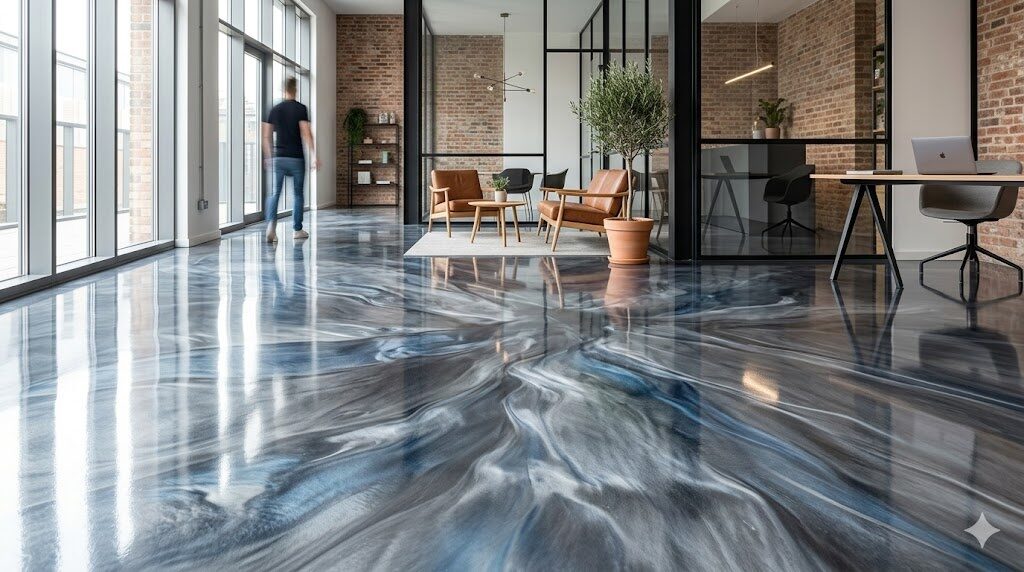
Epoxy Flooring in Bangalore – Industrial & Commercial Solutions by PolyFinish
If you own a factory near Kanakapura Road, a warehouse along the NICE Road corridor, a pharmaceutical unit in Doddakallasandra, or a commercial space near JP Nagar, you have likely asked this question: is epoxy flooring the right choice for my space?
This guide answers that question in full. We cover costs, durability, waterproofing, safety, and why property owners across south Bengaluru consistently choose this high-performance surface system for industrial and commercial spaces. By the end, you will have everything needed to make a confident, well-informed decision.
At Polyfinish Industrial Solutions, we have spent over 15 years transforming floors across Bengaluru’s south zone — from factories in Gottigere to commercial spaces in Banashankari, pharmaceutical units in Doddakallasandra, and logistics hubs near Uttarahalli. Explore our full range of services here.
What Is Epoxy Flooring?
Epoxy flooring is a high-performance surface system made by combining resin with a chemical hardener. When applied over prepared concrete, the resulting chemical reaction creates an extremely hard, seamless, and durable surface that bonds directly to the substrate below — rather than sitting loosely on top of it like tiles or vinyl.
The fully seamless nature of this finish is a critical requirement in pharmaceutical units, food processing plants, and cleanroom environments common across Bengaluru’s south industrial belt around Konanakunte and Kanakapura Road. There are no grout lines, no joints, and no gaps where bacteria or moisture can accumulate.
At Polyfinish, we design and install epoxy flooring systems tailored to each client’s specific operational demands — whether that is a cleanroom, a heavy forklift workshop near Gottigere, or a commercial showroom near Kumaraswamy Layout.
Is Epoxy Good for Flooring? The Honest Answer
Yes — epoxy flooring is genuinely one of the best surface options available for industrial, commercial, and select residential applications in 2026. Here is why:
Outstanding Load-Bearing Strength
A correctly installed system can withstand compressive loads exceeding 10,000 psi. This makes it ideal for factories, warehouses, and car parks where heavy machinery and forklifts operate daily — a standard requirement for facilities along the Kanakapura Road industrial corridor near Konanakunte.
Seamless, Hygienic, and Audit-Ready
The seamless nature of a cured resin surface makes it the first choice for pharmaceutical manufacturing, food processing, and healthcare environments. Facility managers near the industrial estates between Konanakunte and Gottigere specifically request this finish for GMP compliance and hygiene audits.
Wide Range of Finishes
Modern epoxy flooring comes in a wide variety of colours, textures, and finishes — high-gloss for showrooms, matte anti-glare for offices, and textured aggregate finishes for workshops and garages across south Bengaluru.
Fast Installation, Minimal Downtime
A professional installation by our certified team at Polyfinish typically takes 3 to 5 days, including full surface preparation and curing — far less disruptive than tile replacement, which can halt operations for weeks.
Is Epoxy Flooring Waterproof? And Is It 100% Waterproof?
These are among the most common questions we receive from clients across Bengaluru. They deserve a thorough, honest answer.
Is Epoxy Flooring Waterproof?
Yes, epoxy flooring is waterproof. When correctly applied over a well-prepared concrete slab, the cured surface is completely impermeable to water. Spills, wash-down water, and even light flooding will not penetrate a properly installed system. This is why it is the preferred surface for production areas, commercial kitchens, car wash bays, and any zone with regular water exposure.
Is Epoxy 100% Waterproof?
The honest, technical answer: the surface of epoxy flooring is 100% waterproof. However, moisture rising from below the concrete slab — known as hydrostatic pressure — can cause adhesion failure over time if the substrate is not tested and treated correctly before the system goes down.
This is precisely why professional substrate preparation is non-negotiable. Polyfinish tests moisture content in every concrete slab before any installation, whether the project is in Konanakunte, Anjanapura, or Yelachenahalli. No exceptions, no shortcuts.
For areas requiring dedicated waterproofing — such as rooftops and terraces — we also offer terrace waterproofing solutions that work alongside ground-level floor systems.
What Are the Disadvantages of Epoxy Floors?
Complete transparency matters to us. This flooring system is excellent, but it has a few limitations every buyer should understand before investing:
1. Can Be Slippery When Wet — But Easily Fixed
A high-gloss finish can be slippery when wet — particularly in car parks, driveways, and wet processing areas. This is corrected by incorporating anti-slip aggregates such as aluminium oxide or silica sand into the final top coat. Polyfinish always recommends and includes anti-slip additives for commercial and industrial clients across south Bengaluru.
Are Epoxy Floors Slippery? The Full Answer
A smooth, unmodified resin surface has a slip resistance rating similar to polished marble — moderate risk when wet. With anti-slip additives, the same floor exceeds the traction requirements of IS 3779 and relevant international safety standards. A correctly specified epoxy flooring installation with anti-slip treatment is safe underfoot even in wet conditions.
2. UV Sensitivity in Outdoor or Sunlit Areas
Standard resin formulations yellow gradually under prolonged direct sunlight. For outdoor areas or spaces with heavy sun exposure, UV-stable polyurethane top coats are the correct solution — available through our PU Floor Coating service.
3. Not Suitable Over Moving Cracks
This is a rigid surface system. If the concrete beneath has live or moving cracks — common in older buildings across Doddakallasandra and Yelachenahalli — the finish will crack along those same lines. Crack injection and substrate repair before installation is essential. Our team handles this on every project before a single drop of resin is applied.
4. Specific Application Temperature Required
Resin systems must be applied within a temperature range of 10°C to 35°C. Bengaluru’s climate sits comfortably within this window for most of the year, making it one of the best cities in India for year-round installations.
📊 [INSERT COMPARISON TABLE GRAPHIC HERE]
| Feature | Epoxy Flooring | Ceramic Tiles | Vinyl Flooring |
|---|---|---|---|
| Durability | Excellent (20+ years) | Good (10–15 years) | Average (5–10 years) |
| Waterproof | Yes (surface) | Partial (grout sealing needed) | Yes |
| Chemical Resistance | Excellent | Poor | Poor |
| Seamless Surface | Yes | No | No |
| Anti-Slip Option | Yes (additive required) | Yes | Yes |
| Installation Time | 3–5 days | 7–14 days | 3–7 days |
| Cost (₹/sq.ft) | ₹60–₹200+ | ₹80–₹300+ | ₹50–₹150 |
| Best For | Industrial / Commercial | Residential | Light Commercial |
Is Epoxy Flooring Costly Than Tiles? A Bengaluru Cost Comparison
This is a top concern for property owners across Konanakunte, Banashankari, and surrounding localities. Here is a clear, honest breakdown:
Upfront Installation Cost
Good quality ceramic tiles in Bengaluru cost ₹80 to ₹250 per sq.ft for materials alone, plus ₹40 to ₹80 per sq.ft for labour and adhesive. Vitrified and designer options go considerably higher.
A standard 2-coat resin system from Polyfinish is priced between ₹60 and ₹120 per sq.ft. High-build multi-layer epoxy flooring systems with quartz broadcast or anti-static properties range from ₹120 to ₹200+ per sq.ft depending on system specification and area size.
For basic and mid-range applications, this surface system is comparable to — or cheaper than — quality tiles on an upfront basis.
Lifecycle Cost — Where the Real Advantage Is
Tiles chip, grout stains, and industrial areas see tile failures within 3 to 5 years under heavy use. The cost of regrouting, replacement, and factory downtime accumulates fast.
A properly installed resin floor needs only routine cleaning and can serve reliably for 15 to 25 years. Over a 20-year period, epoxy flooring typically costs 40–60% less than tiles for industrial and commercial facilities. This lifecycle figure is what ultimately matters to factory owners and operations managers near Konanakunte.
For a customised quote for your facility, contact Polyfinish directly.
How Long Will Epoxy Flooring Last?
A professionally installed epoxy flooring system lasts 15 to 25 years under normal industrial or commercial conditions. Actual lifespan depends on the following key factors:
What Determines the Lifespan of Your Floor
Surface Preparation Quality: This is the single most important factor. Diamond grinding or shot blasting creates the mechanical profile required for maximum adhesion. Polyfinish uses mechanical surface preparation on every project — no acid-wash shortcuts that compromise long-term performance.
System Thickness: Thin decorative coats at 150–200 microns last 5 to 8 years. A heavy-duty industrial floor at 2mm to 6mm build thickness lasts 20 years or more.
Traffic and Load Intensity: A lightly used office floor will naturally outlast a high-traffic forklift zone, but even intensive industrial use achieves 10 to 15 years with the correct system specification.
Routine Maintenance: Simple cleaning with a neutral pH detergent is all that is required. Avoiding sharp metal drag across the surface preserves the finish for the long term.
📊 [INSERT LIFESPAN BAR CHART GRAPHIC HERE]
| Floor Type | Expected Lifespan |
|---|---|
| PU Floor Coating | 20–30 years |
| Epoxy Flooring (industrial grade) | 15–25 years |
| Ceramic Tiles | 10–15 years |
| Vinyl Flooring | 5–10 years |
| Unsealed Polished Concrete | 5–8 years |
For maximum longevity in pharmaceutical and food-grade environments, explore Polyfinish’s PU Floor Coating as an upgrade from standard resin systems.
Types of Epoxy Flooring Systems Available in Konanakunte, Bengaluru
Not all resin systems are the same. Here are the specific epoxy flooring types Polyfinish installs across south Bengaluru:
1. Self-Levelling Systems
The most popular choice for factories, warehouses, and commercial spaces. Poured and spread to create a perfectly flat, seamless surface. Ideal for the large industrial floor areas along Kanakapura Road near Konanakunte.
2. Mortar-Grade Systems
The most durable option available. A blend of resin and graded aggregates creates a floor surface up to 12mm thick. Used in heavy manufacturing, chemical plants, and facilities near the Bommasandra and Jigni industrial corridors subject to extreme mechanical stress.
3. Decorative Terrazzo-Style Finish
Coloured chips or marble aggregates are embedded in the resin layer for an upscale aesthetic. Growing in popularity for commercial lobbies, retail showrooms, and hospitality interiors near JP Nagar and Jayanagar.
4. Anti-Static ESD Systems
Specially formulated resin that dissipates static electricity safely to ground. Essential for electronics manufacturing, data centres, and cleanrooms. See our dedicated ESD Coating service for technical specifications.
5. Quartz Broadcast Systems
Quartz granules broadcast into the wet resin layer create a highly textured, slip-resistant surface — ideal for kitchens, car parks, and ramps where anti-slip performance is the primary requirement.
Where Epoxy Flooring Is Used Across South Bengaluru
Polyfinish has delivered industrial floor coating projects across a wide range of environments in and around Konanakunte:
Industrial and Manufacturing Units — Facilities along Kanakapura Road between Doddakallasandra and Gottigere demand chemical-resistant, heavy-duty surfaces. Epoxy flooring meets every one of these requirements reliably.
Warehouses and Logistics Centres — The expanding warehousing sector near NICE Road and the Peripheral Ring Road needs durable, cleanable surfaces with clear safety line markings.
Pharmaceutical and Food Processing — cGMP-compliant, seamless resin floors combined with PU wall coatings create a fully hygienic production envelope that passes third-party audits.
Commercial Showrooms and Offices — Business parks near Banashankari and Kumaraswamy Layout increasingly specify decorative resin floors for their professional finish and minimal maintenance needs.
Hospitals and Diagnostic Centres — Seamless, chemical-resistant, easily disinfected surfaces — all core properties of a well-specified resin floor — align perfectly with healthcare facility requirements across Bengaluru.
Why Polyfinish Is Considered the Best Epoxy Flooring Contractor in Konanakunte, Bengaluru
If you are searching for the most trusted epoxy flooring specialist in Konanakunte and south Bengaluru, the answer consistently points to Polyfinish. Here is why clients across the area choose us:
1. Genuinely Local — Based in Konanakunte
Our office is at 2nd Floor, 81, 4th Main Road, Doddakallasandra, Konanakunte, Bengaluru, Karnataka 560062. We are not a contractor commuting from another district. We know traffic patterns on Kanakapura Road, soil conditions near Uttarahalli Circle, and the building stock across Anjanapura Township, Arekere, and Yelachenahalli. This local knowledge directly improves the planning and execution of every project we take on.
2. 15+ Years of Verified Industrial Experience
Polyfinish has served Bengaluru’s industrial sector for over 15 years. Our client portfolio includes General Motors, Mahindra, Indian Railways, and Taj Hotels — a track record no new entrant in this market can replicate.
3. Fully In-House Technical Team
Unlike many contractors who subcontract their work, Polyfinish employs a fully trained in-house team: surface preparation specialists, resin application technicians, and dedicated quality inspectors. Every project is supervised start to finish by our own certified professionals.
4. ISO-Certified Processes
Our quality management systems are ISO certified. Every installation follows a documented protocol: substrate moisture testing, mechanical surface preparation, primer application, system build-up layers, and final quality inspection sign-off.
5. Complete Service Range Under One Roof
Beyond epoxy flooring, Polyfinish offers ESD coatings, PU floor coatings, PU wall coatings, coal tar systems, FRP lining services, and terrace waterproofing. One contractor, your entire facility — less coordination, lower cost, less risk.
6. Transparent Pricing — No Surprises
We provide detailed written quotations covering materials, labour, surface preparation scope, and warranty terms in full. No hidden charges after the project begins.
7. 500+ Projects, 98% Client Satisfaction
Our completed project count and client satisfaction score across Konanakunte, JP Nagar, Gottigere, Yelachenahalli, and south Bengaluru demonstrates consistent, repeatable quality. Read more about our story here.
Explore further: related epoxy flooring guides
Every project has a different starting question. Whether you want to understand costs, compare system types, or scope an industrial-grade installation — these guides go deeper on each topic.
Epoxy flooring cost per sqft in Bangalore (2026) A breakdown of real 2026 pricing across system types — basic 2-coat, self-levelling, anti-static, and PU — with honest cost ranges so you can budget before calling anyone. 👉 Read the cost guide
Industrial epoxy coating in Bangalore — types, cost & process If your facility is a factory, warehouse, or pharmaceutical unit, this guide covers the right heavy-duty system for your load conditions, chemical exposure, and compliance needs. 👉 Read the industrial guide
Epoxy floor paint vs epoxy flooring — what’s actually different? They’re often confused but are fundamentally different products. This comparison covers durability, film thickness, cost, and which one is appropriate for your specific facility in Bangalore. 👉 Read the comparison
How to Choose the Right Floor Coating Contractor in Bengaluru
Before hiring any contractor in the Konanakunte area, ask these critical questions:
Do they carry out mechanical surface preparation?
Diamond grinding or shot blasting is essential before any resin system goes down. A contractor proposing only acid washing is cutting corners that will cause early system failure.
Do they test for substrate moisture content?
Moisture trapped beneath the slab is the leading cause of resin floor delamination. Insist on a documented moisture reading before work begins.
What is the specified dry film thickness?
Get the DFT in writing. Epoxy flooring for industrial use should be a minimum of 500 microns; heavy-duty applications need 2mm or more.
Is there a written warranty?
Polyfinish provides a written warranty on every installation. Any credible contractor should offer the same assurance in writing.
Can they provide local verified references?
Ask specifically for references in Konanakunte and south Bengaluru to confirm genuine operational presence in your area.
Maintaining Your Floor: Keep It Looking New for Decades
One of the most valued advantages of epoxy flooring is how little maintenance it demands:
Daily Cleaning: Sweep or dust mop to remove loose debris. Mop with clean water and a neutral pH detergent for routine upkeep.
Spill Management: Clean up chemical or oil spills immediately. The non-porous, waterproof surface means most residues wipe away with minimal effort.
Avoid: Abrasive scrubbing pads, highly acidic or alkaline cleaning products, and sharp metal objects dragged directly across the surface.
Annual Check: Have a qualified technician inspect annually for early signs of wear or surface lifting at high-traffic zones. Preventive recoating is always more cost-effective than full system replacement.
For maintenance and recoat services across south Bengaluru, contact the Polyfinish team.
Comparing Resin Floors Against Other Surface Options
Epoxy Flooring vs. PU Flooring
Polyurethane flooring offers greater flexibility and superior thermal shock resistance — the preferred specification for food and beverage facilities with steam cleaning and freezer areas. Polyfinish offers both. Visit our PU Floor Coating page to understand when PU is the better choice for your facility.
Epoxy Flooring vs. Polished Concrete
Polished concrete looks attractive but provides minimal chemical resistance and is not a seamless surface. A resin floor delivers a complete protective barrier against chemicals, moisture, and contamination that polished concrete simply cannot achieve.
Epoxy Flooring vs. Vinyl Tiles
Vinyl is inexpensive and quick to fit, but it lacks chemical resistance, is not seamless, and will not withstand heavy forklift loads. On every industrial performance measure, a properly specified resin system is the superior long-term choice.
Frequently Asked Questions About Epoxy Flooring in Konanakunte
Is epoxy flooring suitable for homes in Bengaluru?
Yes. Decorative resin systems are growing in popularity in Bengaluru homes — particularly for garages, kitchens, and basements. They are seamless, low-maintenance, and available in a wide range of finishes. For main living areas, many homeowners pair this with warmer surface materials for aesthetic balance.
How soon can I use the floor after installation?
Light foot traffic is typically possible 24 hours after installation. Full cure for heavy vehicle or forklift traffic takes 5 to 7 days depending on site temperature and humidity levels. Bengaluru’s climate supports smooth, consistent curing for most of the year.
Is there an odour during installation?
Solvent-based systems produce a noticeable smell during application. Polyfinish uses water-based and low-VOC formulations wherever client environments require it — pharmaceutical facilities, hospitals, and occupied commercial buildings in particular. Adequate ventilation during installation is always recommended regardless of system type.
Can it be applied over existing floor tiles?
In some cases, yes — but only following a thorough assessment. Existing tiles must be fully adhered with no hollow spots, and the surface needs to be mechanically profiled. For most industrial settings, direct application over a prepared concrete slab gives the strongest and most durable long-term result.
Book Your Free Epoxy Flooring Consultation in Konanakunte, Bengaluru
You have completed your research. Now take the next step.
Whether you need epoxy flooring for a factory, warehouse, pharmaceutical unit, commercial space, or car park anywhere in Konanakunte, Doddakallasandra, Yelachenahalli, or across south Bengaluru — Polyfinish is ready to help you get it right.
Our team will visit your site, assess the substrate, understand your operational requirements, and deliver a fully transparent quotation with complete system specifications. No sales pressure, no hidden charges.
For additional guidance on industrial coating standards and best practices, refer to the American Concrete Institute’s guidelines on floor coatings globally recognised authorities on surface coating specification and quality.
The Constructor — A comprehensive technical guide on epoxy floor types, applications, and specification standards
The World Floor Covering Association and leading flooring industry bodies globally consistently advise against using thin-film epoxy paints in any space with machinery, vehicles, or chemical exposure. You can review international flooring industry standards and technical resources to understand why film thickness and adhesion strength matter so critically.
For authoritative guidance on flooring performance standards, refer to the Indian Green Building Council (IGBC), which covers material benchmarks for industrial facilities across India.
Business Name: Epoxy Coating Bangalore – Polyfinish
Address: 2nd Floor, 81, 4th Main Road, Doddakallasandra, Konanakunte, Bengaluru, Karnataka 560062
Phone: +91 9380450875
Website: https://polyfinish.in
Our Services: Epoxy Coating | ESD Coating | PU Floor Coating | PU Wall Coating | Coal Tar Epoxy | FRP Coating | Terrace Waterproofing
→ Book Your Free Site Visit Today
Polyfinish Industrial Solutions — Bengaluru’s trusted epoxy flooring specialist, serving Konanakunte, Doddakallasandra, Kanakapura Road, JP Nagar, Banashankari, Kumaraswamy Layout, Uttarahalli, Gottigere, Anjanapura, Yelachenahalli, and Arekere since 2009.